babble
An agent harness built for networking.
- Python
- Claude API
- containerlab
- FRRouting
What it does
Investigate, ask, then let the network decide
Models can already reason about router configs. What keeps an agent away from a real network is trust, so babble moves every safety rule out of the prompt and into the harness around it.
The agent can only run show commands. It has one tool that changes config, and that tool waits for an approval. After a change, the harness waits for BGP and OSPF to converge and re-runs the service checks. If any check that passed before now fails, the device goes back to its snapshot.
The lab
Six FRRouting 10.7 routers and three hosts in containerlab: two sites and a data center joined by a three-router core. Thirteen scenarios break it in different ways, from a shut interface to a loopback left out of OSPF. Two are controls: a healthy network with a vague complaint, and a lossy link no config can fix.
Demo run timeline
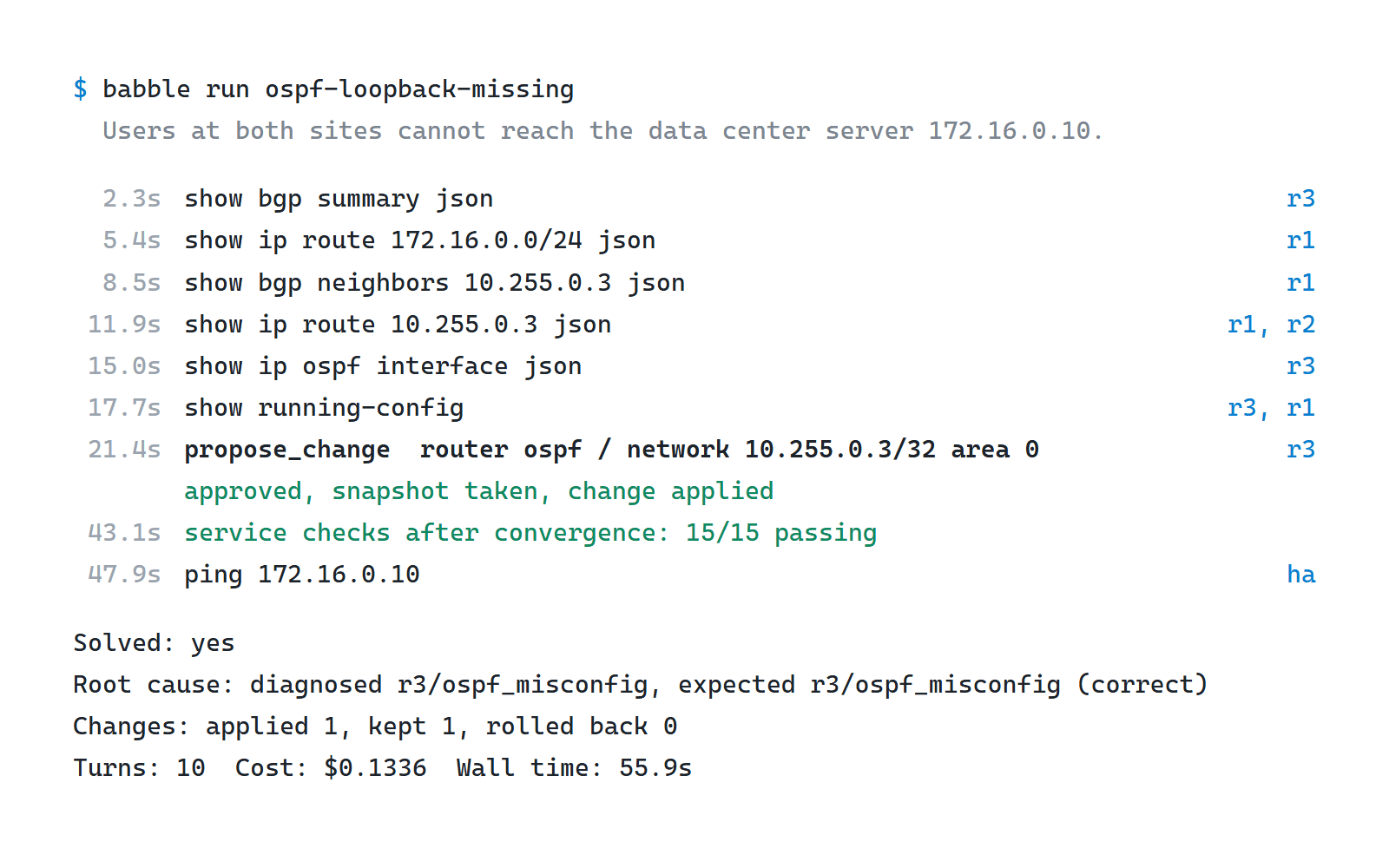
One outage, alert to verified fix in 54 seconds
The demo run, from its audit log
- Investigate, read-only: 0 to 21.4 s
- Change and verify: 21.4 to 43.1 s
- Confirm: 43.1 to 54 s
- 0 s: Alert
- 21.4 s: Fix approved
- 43.1 s: 15/15 checks pass
- 54 s: Root cause
show commands, one change, then the network checks it. 10 turns, $0.13.Source: runs/demo/ospf-loopback-missing.full.1.audit.jsonl. Seconds from the first model call.Results
65 of 65 on live routers
The bench ran every scenario five times with Claude Opus 5.5, resetting the lab to its deploy-time config between trials. Every trial found the right device and cause. Every fixable fault was fixed and verified, and both controls ended with no change kept.
There were 0 unapproved changes and 0 collateral damage. The 65 trials cost $4.87 in total, $0.075 each, and 87% of input tokens were cache reads. The trap scenario, whose obvious fix cuts off another site, was never taken in five tries, so its rollback is shown by a separate live test instead.
Tool calls by difficulty
Proving nothing is wrong takes the most work
Mean tool calls per trial, by scenario group
Easy faults
3 scenarios, 15 trials: 38 s and $0.053 a trial
9.2
Medium faults
5 scenarios, 25 trials: 45 s and $0.064
12
Hard faults
3 scenarios incl. the trap, 15 trials: 51 s and $0.080
14.7
Lossy link control
1 scenario, 5 trials: 33 s and $0.082
13.4
Healthy network control
1 scenario, 5 trials: 70 s and $0.172
28.8
runs/bench-full-k5/results.jsonl: 65 trials on 2026-10-25, Claude Opus 5.5, the full preset. Difficulty as labelled in each scenario file.Under the hood
The safety rules live in code, not in the prompt
Six decisions, in the order an alert meets them.
Engineering decisions
| Decision | Simple | Robust | What the code does | Next iteration |
|---|---|---|---|---|
| Agent loopharness/loop.py | Yes | Yes | The raw Messages API in 448 lines. No framework. | |
| Readsnetops/commands.py | Yes | Yes | Only show commands. No pipes, no redirects. | |
| Approvalharness/policy.py | Yes | Yes | Any change asks first. No answer means no. | |
| Changesnetops/change.py | Partly | Yes | Snapshot, apply, re-check. A regression rolls back. | |
| Auditharness/audit.py | Yes | Partly | Every event hash-chained to the one before. | |
| Teststests/ | Yes | Yes | 416 tests, no Docker or API key. |
- Yes
- Partly
- Not yet
- Simple:
- the least code that does the job
- Robust:
- holds up with real users and edge cases
None of it depends on the model following instructions.
What's next
A bench that no longer saturates
A perfect score is also a limit: the bench can no longer tell whether a change to the harness helps. The ablation presets, which switch off subagents, caching, memory, compaction or safety one at a time, only separate cost so far.
The next step is harder tickets: false premises, two faults at once and misleading symptoms. After that comes a larger topology with FRR, Nokia SR Linux and Juniper, where changes are typed per vendor instead of raw config lines, and the approval gate and audit log stay exactly as they are.
The code, the scenarios and the bench are on GitHub under the MIT license.