Review Sentiment Analysis Model
Comprehensive sentiment analysis system that scrapes professor reviews, trains dual ML models, and provides an interactive dashboard for analyzing student sentiment across departments.
- Python
- PyTorch
- Flask
Problem
Students at Penn State lacked comprehensive tools to analyze professor reviews beyond simple ratings. Traditional review systems didn't account for the nuanced relationship between difficulty and quality, making it challenging to identify truly excellent professors versus easy graders. Additionally, manual analysis of thousands of reviews was impractical for extracting meaningful departmental insights.
Solution
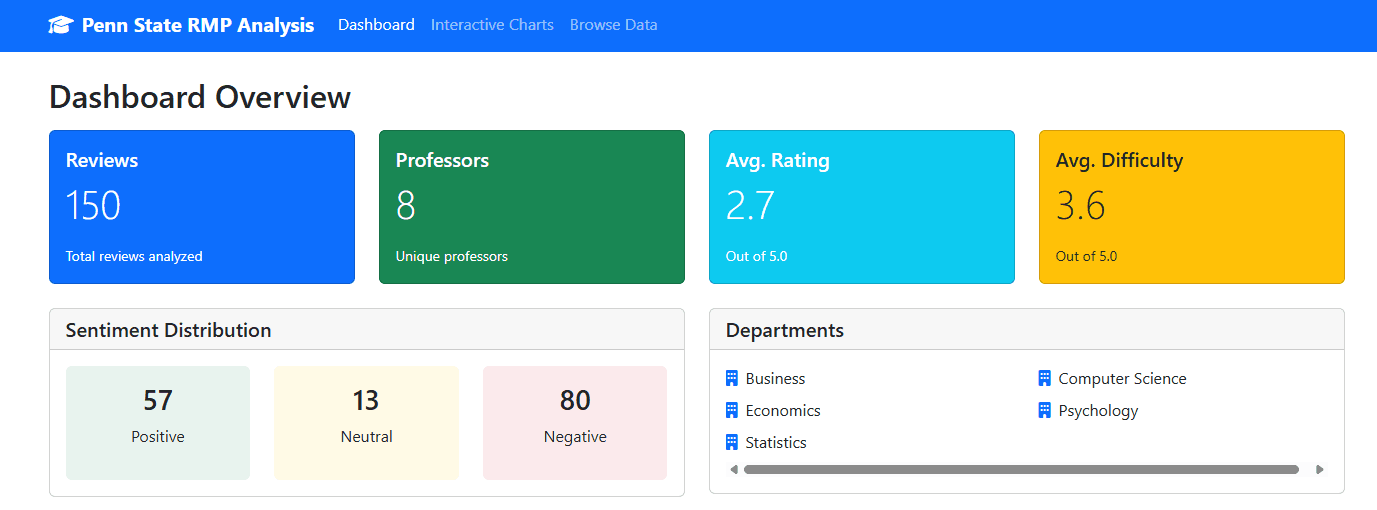
Developed a comprehensive sentiment analysis system featuring dual ML models: a standard rating-based model and an innovative combined model that incorporates difficulty scores and metadata. The system automatically scrapes Rate My Professors data, processes reviews using DistilBERT transformers, and provides real-time insights through an interactive Flask dashboard. Implemented automated daily pipeline runs with performance tracking to continuously improve model accuracy over time.
Dashboard overview
Reflection
This project deepened my understanding of NLP model fine-tuning and the complexities of web scraping at scale. Working with transformer models taught me about the trade-offs between model complexity and inference speed. The automated pipeline development highlighted the importance of robust error handling and monitoring in production ML systems. Building the comparative analysis between models revealed insights about when traditional metrics might not capture the full picture of model performance. Future enhancements would explore multi-university datasets and temporal sentiment tracking across academic terms.